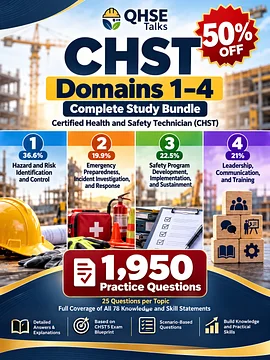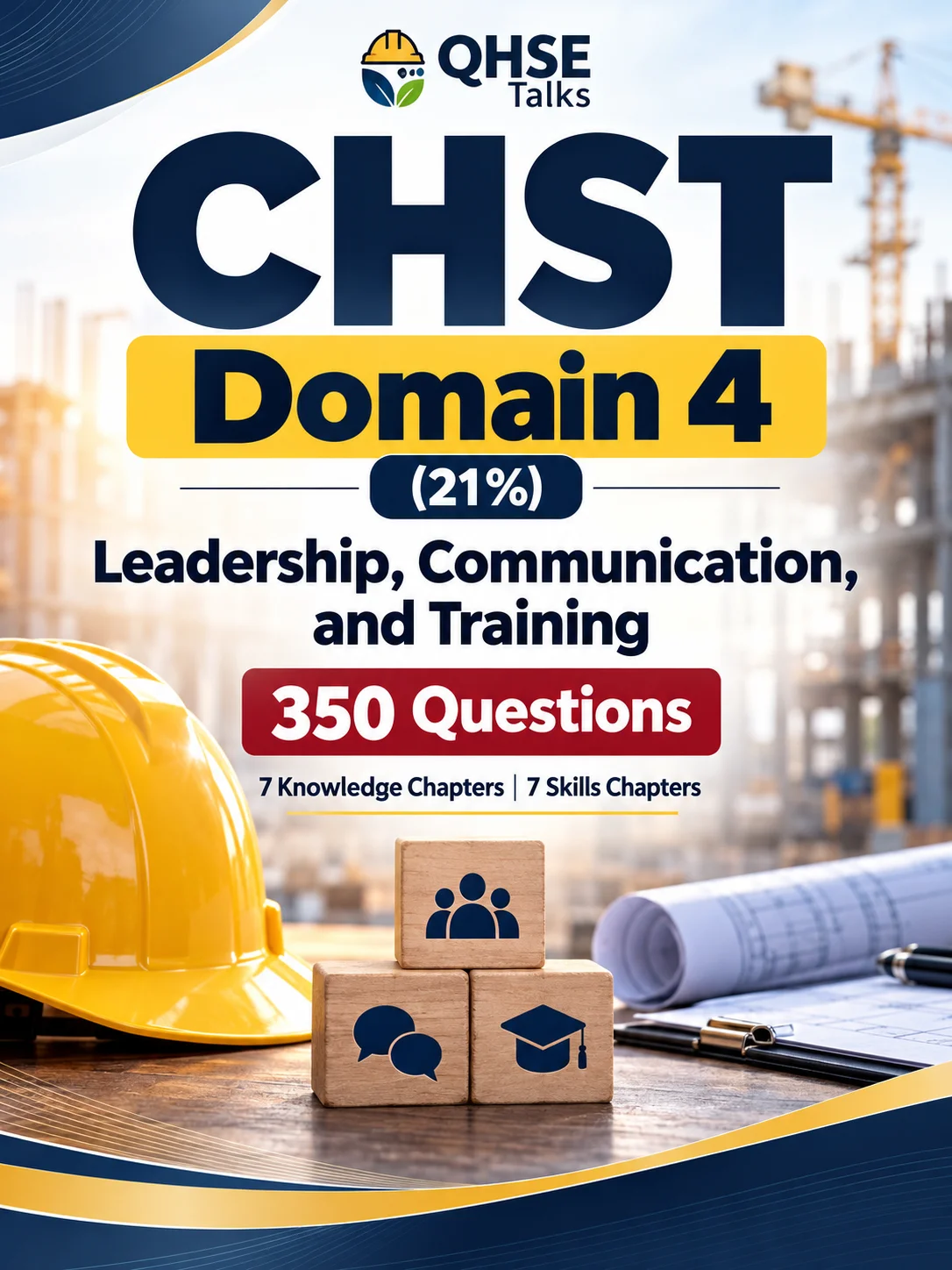
CHST Domain 4 – Leadership, Communication, and Training (21%) 350 Multiple-Choice Practice Questions with Detailed Answers | QHSE Talks
Prepare for the Certified Health and Safety Technician (CHST) examination with the QHSE Talks CHST Domain 4 Question Bank, a comprehensive practice resource dedicated to Leadership, Communication, and Training, representing 21% of the CHST examination.
This question bank is designed to help CHST candidates strengthen their technical knowledge, develop practical decision-making skills, and improve their ability to apply safety principles in realistic construction and occupational safety scenarios.
With 350 challenging multiple-choice questions, 7 Knowledge Chapters, and 7 Skills Chapters, this resource addresses every Knowledge and Skill statement covered in CHST Exam Domain 4.
WHAT'S INCLUDED?
350 Multiple-Choice Questions
-
7 Knowledge Chapters – 175 Questions
-
7 Skills Chapters – 175 Questions
-
25 Questions for Each Knowledge and Skill Statement
-
Detailed Answers and Explanations at the End of Each Chapter
KNOWLEDGE CHAPTERS – 7 CHAPTERS
Chapter 1 – Available Training Delivery Methods and Instructional Material
Understand training delivery methods, instructional design, learning objectives, adult learning principles, training effectiveness, and competency assessment.
Chapter 2 – Appropriate Human Behavior Motivation Methods and Techniques
Explore motivation theories, reinforcement techniques, behavioral influences, employee engagement, incentives, just culture, and strategies for encouraging safe behavior.
Chapter 3 – Communication Strategies
Develop your understanding of effective communication, active listening, risk communication, feedback, conflict management, communication barriers, and workplace information exchange.
Chapter 4 – When to Consult with Equipment Manufacturers, Suppliers, or Subject Matter Experts
Understand when specialized technical knowledge is necessary and how to obtain reliable information to support safety decisions.
Chapter 5 – Information Confidentiality Requirements
Study confidentiality principles, privacy responsibilities, sensitive information handling, and appropriate communication and documentation practices.
Chapter 6 – Leading Risk Management Strategies and Techniques
Explore risk management leadership, critical controls, risk ownership, risk reduction strategies, hazard identification, and effective decision-making.
Chapter 7 – Leadership Strategies
Understand leadership approaches, transformational leadership, situational leadership, influence, credibility, organizational culture, and visible management commitment.
SKILLS CHAPTERS – 7 CHAPTERS
Chapter 8 – Develop Site-Specific Safety Training Requirements Based on Job Tasks and Work Environment
Chapter 9 – Manage Applicable Documents
Chapter 10 – Identify Existing and Foreseeable At-Risk Conditions and Behaviors
Chapter 11 – Recognize Situations or Behaviors That Present Danger
Chapter 12 – Access Relevant and Current Information
Chapter 13 – Recognize and Address Total Worker Health
Chapter 14 – Complete Risk Reduction Activities
HOW TO USE THIS QUESTION BANK
For the best learning experience:
-
Complete the 25 questions in each chapter before checking the answers.
-
Practice under timed conditions, aiming for approximately one minute per question.
-
Mark questions you guessed on, even when your answer was correct.
-
Review the detailed explanations and understand why the correct option is stronger than the alternatives.
-
Revisit missed questions after a few days to reinforce your understanding.
The explanations are intended to develop your reasoning and help you recognize the principles behind the correct answers.
WHY CHOOSE QHSE TALKS?
QHSE Talks develops educational resources focused on helping safety professionals understand the principles behind occupational health and safety requirements.
Our approach emphasizes critical thinking, practical application, and the ability to make sound professional decisions when facing unfamiliar workplace situations.